Final report
Narrative attention on Kiva — the full written report, in English.
This is the primary reading version of the report. It is translated from
REPORT.md, the Chinese original that was submitted at the hackathon and is retained as the submitted artefact. Every figure, confidence interval and source citation is carried over unchanged.
Technical summary
We split "slow funding" into two attention channels to be tested separately: current competition — the
same-sector loans live at this moment are both numerous and alike — and a recent-listing language proxy —
the same-sector loans that went live 35–65 days earlier are both numerous and alike. The second channel has no
observed impressions, page exits or memory, so it can only serve as a posting-age proxy for the wear-out
hypothesis. The main model uses 1,234,131 training loans from 2016–2024; the 133,409 loans in the 2025 main
sample are held out in time. [Source: outputs/model_sample_flow.csv, outputs/frozen_spec.csv]
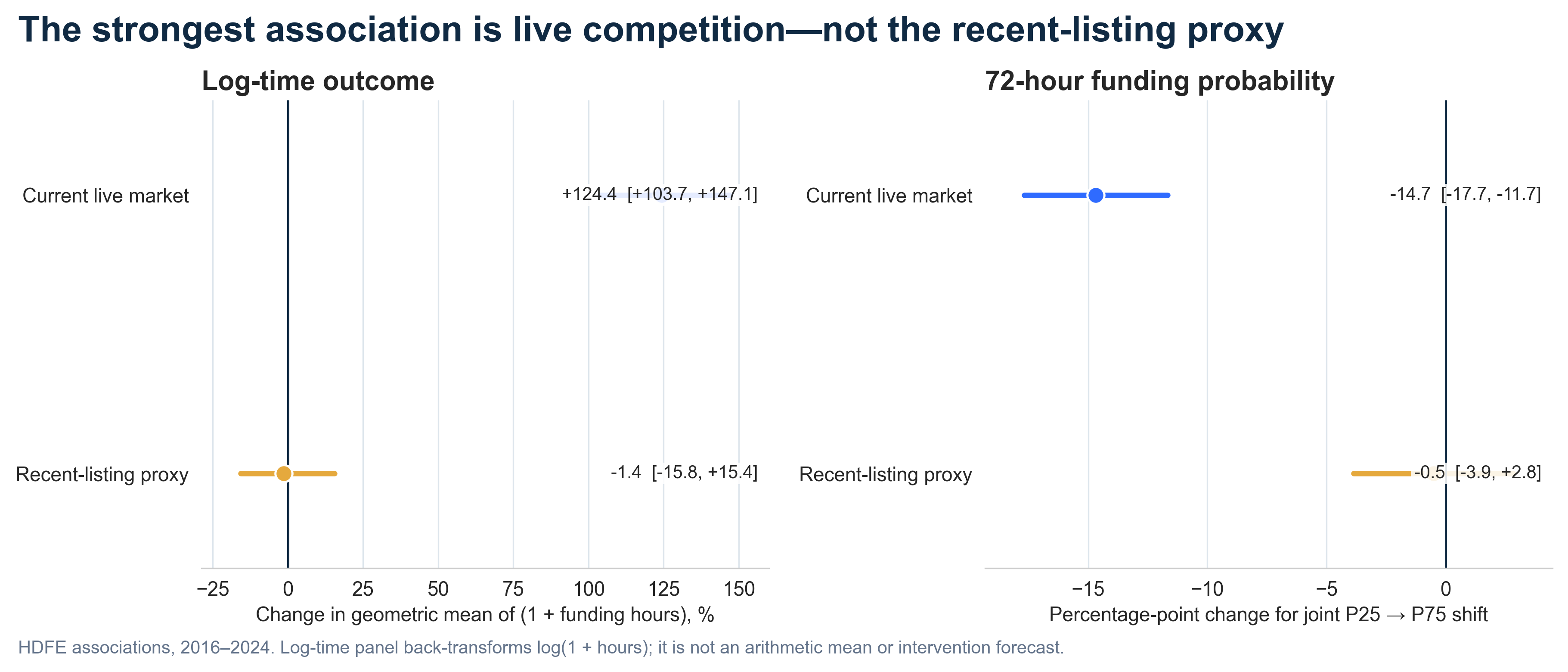
The strongest result comes from the current environment. In the log(1 + funding hours) model, moving current
volume and focal-to-pool lexical overlap together from the training-sample P25 to P75 corresponds to a
124.35 % increase in the conditional geometric mean of 1 + funding hours (95 % CI 103.71 % to 147.08 %),
a ratio of 2.24. This is not an arithmetic mean funding duration. On the separate 72-hour co-outcome, the
probability of completing funding falls by 14.68 percentage points (95 % CI −17.69 to −11.67 pp).
[Source: outputs/scenario_contrasts.csv]
The recent-listing proxy does not produce a result of comparable strength: the joint P25 → P75 scenario is
−1.42 % on the same log-time back-transform (95 % CI −15.81 % to 15.43 %), and −0.51 pp on the 72-hour
probability (95 % CI −3.86 to 2.84). Both intervals cross zero, so the local V×G interaction cannot be
promoted into a robust average wear-out conclusion. [Source: outputs/scenario_contrasts.csv]
The 2025 holdout narrows the actionable boundary further. Adding the narrative features gives a log-hour MAE of
0.9822 against 0.9663 for controls only on the sample with a complete 35-day follow-up; the 72-hour Brier score
is 0.1370 against 0.1357 and AUC is 0.8921 against 0.8986. Log-loss improves slightly, from 0.4317 to 0.4301,
but not nearly enough to support deploying borrower scoring. [Source: outputs/holdout_validation.csv]
Recommendation: do not deploy the Narrative Attention Engine to score borrowers. Use current saturation as an experiment trigger, and test listing schedule / exposure diversification and partner-approved template alternatives first.
Scope and data boundaries
- The official data contains 1,453,846 loans spanning 2016-01-01 to 2025-12-31. Six records with
raisedDate < fundraisingDateare excluded. [Source:outputs/data_profile_summary.csv] - Every record in this extract has a
raisedDate. The extract therefore cannot identify true right censoring and does not support reading the outcome as "the probability of funding across all posted loans". What is analysed here is the loans in the extract with an observedraisedDate. [Source:outputs/status_raised_crosstab.csv] - The main outcome is
log(1 + funding hours), with 72-hour fast funding reported as a co-outcome. Records at the end of 2025 with less than 72 hours of follow-up are excluded from the 72-hour evaluation. [Source:outputs/followup_eligibility.csv] - All times are UTC. The training period is 2016–2024; IDF, standardisation parameters and every learned step
are fitted on the training period only and then applied unchanged to 2025. [Source:
outputs/frozen_spec.csv] - Fields determined only after listing, such as
fundsLentInCountry, are excluded from the model. No output contains names, precise locations or full narrative text.
Measurement design: rebuilding the attention market at the moment of listing
For each focal loan we compute two same-sector environments:
- Current channel —
C = log1p(active same-sector count);H = mean cosine similarity between the focal narrative and the active pool(focal-to-pool lexical overlap, not pairwise homogeneity within the pool). Current saturation is the standardisedC×H. - Recent-listing proxy —
V= volume of earlier loans within a posting-age window of [35, 65) days, weighted with a 7-day half-life;G= mean similarity to that same weighted pool. Proxy saturation is the standardisedV×G. The main pool does not require the earlier loans to have finished, and there is no lender exposure data; a completed-only lag pool is used as a sensitivity check.
The primary text field is use, masked for names, locations, amounts and dates. TF–IDF uses hashed word
unigrams and bigrams (2^17 features) with smoothed IDF fitted on the training period only. 409 verbatim
five-grams appearing in at least 659 training documents and across at least 3 countries are defined as
recurring language. Because the data has no partner ID, "across countries" is only a proxy for shared origin
and cannot attribute language to any particular institution.
[Source: audit/stage2_text_manifest.json, outputs/boilerplate_like_phrases.csv]
Similarity is not computed by brute-force pairwise enumeration but through the exact identity
mean cosine = focal vector · mean pool vector. Across 600 checks — 200 focal loans × 3 pools — the maximum
absolute error is 2.909e-14 raw and 2.509e-14 residual, below the 1e-9 acceptance threshold.
[Source: outputs/pool_identity_summary.csv, audit/stage3_feature_manifest.json]
The P25/P75 joint scenario also passes a local support check: within a neighbourhood of ±0.10 IQR on both
dimensions, each current and recent endpoint has at least 4,716 real training records behind it. This check
only establishes that the scenario endpoints are not hollow extrapolation; it does not establish
exchangeability or causal identification. [Source: outputs/joint_support_summary.csv]
Finding 1 — Current market saturation is a strong but non-causal diagnostic signal
The main HDFE model controls for loan amount, borrower count, repayment term and platform 7-day listing
volume, and absorbs country, activity, week, gender, repayment interval and posting day/hour fixed effects.
Standard errors are two-way clustered on country and week. The C×H coefficient is 0.1017
(95 % CI 0.0357 to 0.1677, p = 0.003308). [Source: outputs/rq1_main_table.csv]
The substantive reading uses the full joint scenario rather than translating the interaction coefficient into
a percentage on its own: moving current volume and focal-to-pool lexical overlap together from P25 to P75
corresponds to +124.35 % in the conditional geometric mean of 1 + funding hours and −14.68 pp in the
72-hour probability. The first is not an arithmetic mean funding duration, and both are conditional
associations in observational data — not intervention forecasts for a redesigned Kiva.
[Source: outputs/scenario_contrasts.csv]
Finding 2 — Template language may contribute to the current signal, but no causal decomposition is possible
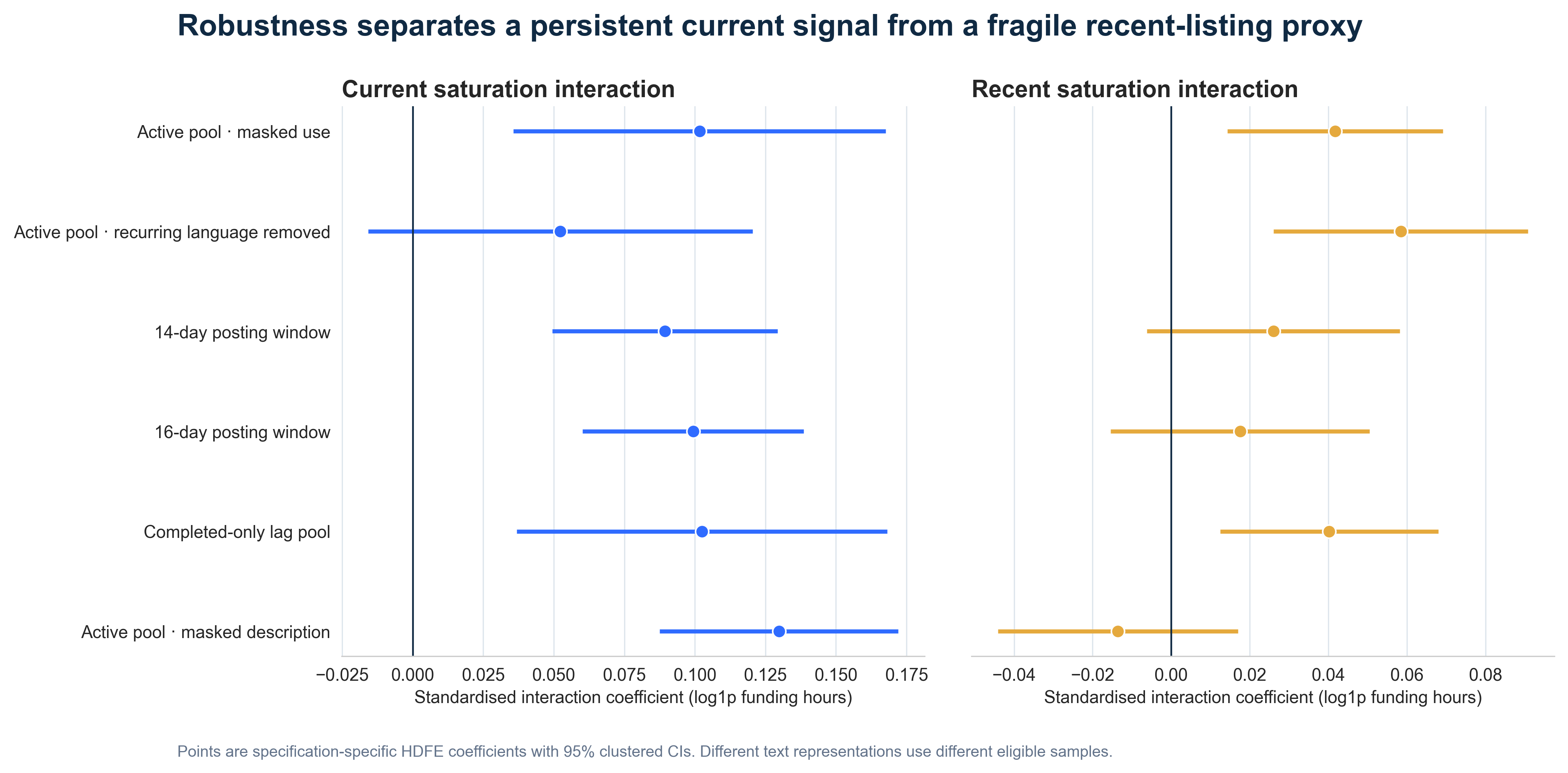
On raw masked use, C×H is 0.1017 (p = 0.003308); with recurring language removed it is 0.0523 (p = 0.129).
The estimate roughly halves and no longer reaches conventional significance — but this does not mean
"templates explain half of it", because the difference between the two coefficients has not been put through a
formal cross-model difference test. [Source: outputs/robustness.csv]
The description sensitivity provides complementary evidence: on masked description, C×H is 0.1298
(95 % CI 0.0875 to 0.1721, p = 1.663e-07) while V×G is −0.0136 (95 % CI −0.0441 to 0.0170, p = 0.376). The
identity check over 50 focal loans × 2 pools has a maximum error of 1.721e-15, passing the 1e-9 standard.
[Source: outputs/description_robustness.csv, audit/description_robustness_manifest.json]
The managerial implication is not to ask borrowers to "tell it louder", but to test the platform's and the lending partners' templates, scheduling and exposure processes.
Finding 3 — A local recent-listing interaction cannot be promoted to average wear-out
The raw V×G coefficient is 0.0417 (p = 0.003658) and the residual is 0.0585 (p = 0.0007078). But these
coefficients test the conditional interaction of a posting-age proxy. The joint P25 → P75 scenario includes
V, G and V×G together, and its log-time back-transform is −1.42 % with a confidence interval that
crosses zero. [Source: outputs/robustness.csv, outputs/scenario_contrasts.csv]
At the same time, current C×H stays positive and significant under both 14-day and 16-day posting windows,
while lagged V×G is not significant in the time-based specifications. The current result is therefore robust
to the window choice but sensitive to text decomposition, and the recent result is not strong enough to
justify prioritising a wear-out editorial intervention. [Source: outputs/robustness.csv]
Temporal and segment heterogeneity — real, but not for ranking
Year-specific scenario contrasts across 2016–2024 show both channels fluctuating substantially, and global
heterogeneity screens on year, sector and country all indicate differences. [Source: outputs/rq3_year_effects.csv,
outputs/rq3_global_tests.csv, outputs/rq4_sector_global_tests.csv, outputs/rq4_country_global_tests.csv]
These results stay exploratory. Country heterogeneity covers only the 15 countries with the highest training volume, and the sector models cover the 14 sectors that meet the estimation threshold. Many subgroup confidence intervals are wide, and the global Q screen does not estimate the cross-group covariance induced by shared week shocks. The report therefore does not pick a "best country" or "best sector" out of a ranking, and certainly does not use heterogeneity for borrower targeting.
2025 holdout — the explanatory signal does not become stable incremental prediction
On the 123,489 loans in 2025 with at least 35 days of follow-up, log-hour MAE is 0.9663 for controls only
against 0.9822 with narrative features; hour MAE is 168.28 against 168.61.
[Source: outputs/holdout_validation.csv]
On the 72-hour evaluation, Brier is 0.1357 against 0.1370 and AUC is 0.8986 against 0.8921; log-loss is 0.4317
against 0.4301. We did not compute paired uncertainty for these metric differences, so the accurate statement
is that the narrative model did not beat the baseline on the main operational metrics — not that it is
significantly worse. [Source: outputs/holdout_validation.csv]
Calibration still shows visible gaps across several gender and sector subgroups. These diagnostics are
guardrails only and cannot be a basis for protected-group targeting. [Source: outputs/fairness_diagnostics.csv]
Recommendation — run platform experiments, not borrower scoring
Pilot A · Scheduling and exposure under current saturation
- Entry condition: a pre-defined high-current-saturation market state. Not conditioned on borrower quality.
- Randomisation: business-as-usual exposure versus staggered listing / diversified related-loan exposure.
- Primary outcomes: time-to-funding, 72-hour funding probability.
- Guardrails: total funding volume, allocation across countries and sectors, fairness, borrower workload.
Pilot B · Partner-approved template alternatives
- The randomisation unit and the intervention content must be fixed by Kiva and the lending partners before launch.
- Compare the current template against several compliant alternatives. Borrowers must not be asked for more sensitive or longer personal narratives.
- Pre-register the MDE, analysis window, stopping rule and heterogeneity tests to prevent post-hoc selection.
Explicitly out of bounds
- Do not deploy the Narrative Attention Engine as a borrower ranking, approval, penalty or auto-rewriting tool.
- Do not interpret a saturation score as borrower quality, creditworthiness or moral worth.
- Do not adjust exposure on the basis of uncalibrated subgroup scores.
Key limitations and the questions that follow
- The data has no impressions, ranking, clicks, promotion, image quality or partner ID. Any of these omitted factors could drive both saturation and funding speed.
- The duration of the active pool is itself affected by earlier funding outcomes, so endogeneity remains. The 14- and 16-day pre-committed posting windows reduce but do not eliminate the confounding.
- TF–IDF measures lexical repetition, not semantics, visual appeal or multilingual perception, and country is only a proxy for origin. The main recent pool is defined by posting age; it does not prove that the earlier loans had left the page, been seen by lenders, or left a memory.
- The raised-only extract limits extrapolation. These results cannot stand in for the success probability of all posted loans.
- The 2025 holdout exposes temporal drift. Any operational application must be recalibrated and validated through a prospective experiment.
The two most important next questions: how much of the current association survives once real exposure and ranking logs are added, and does randomly changing the listing mix actually improve funding speed without diverting attention away from other disadvantaged borrowers?
Reproducibility and file index
- Executed notebooks:
notebooks/S0_prepare.ipynbthroughnotebooks/S6_engine.ipynb. - Full implementation:
src/. Execution order is inRUNBOOK.md. - Core results:
outputs/scenario_contrasts.csv,outputs/robustness.csv,outputs/holdout_validation.csv. - 300 dpi figures with paired source CSVs:
figures/andfigures/source_data/. - Quality and run evidence:
audit/,logs/run_log.txt. - Official challenge objectives, dates and judging criteria: UNSW Marketing Analytics Hackathon Challenge 2026.
Version note: this report is written from the full real outputs. The runbooks and prompts in the appendix are early team source material only; the saved code, audit trail and frozen specification govern what was actually executed.